> For the complete documentation index, see [llms.txt](https://help.immodio.app/llms.txt). Markdown versions of documentation pages are available by appending `.md` to page URLs; this page is available as [Markdown](https://help.immodio.app/en-start/guides-group/tenancies/create-a-tenancy-agreement/rent.md).
# Rent
**General**
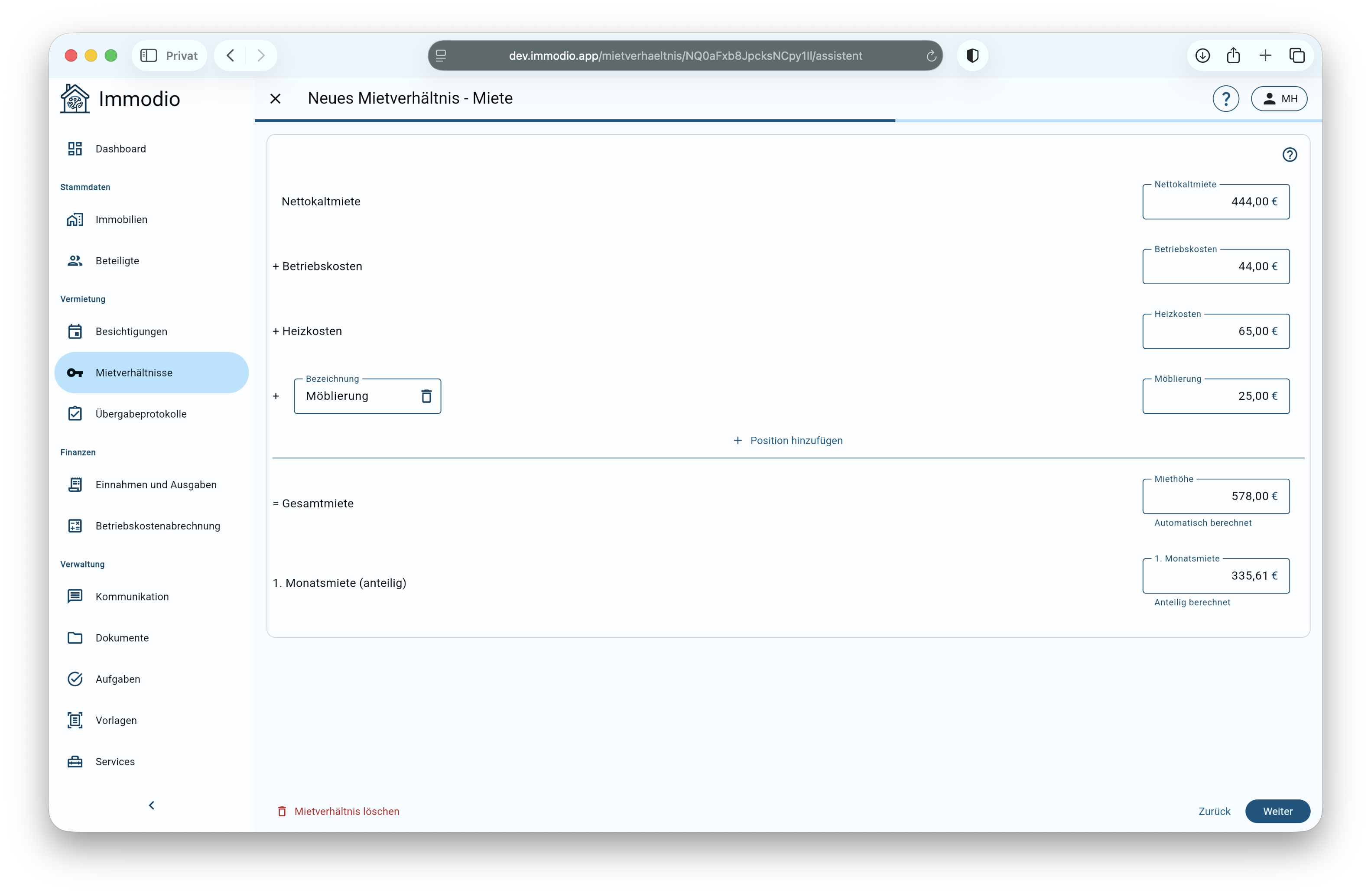
In this step, an overview of the individual rental items is displayed. The total rent is calculated automatically. If a garden or parking space is assigned to the unit, it will automatically be included in the list. If these items are already included in the net cold rent, an amount of €0 can be entered here. These items are displayed automatically if there is a corresponding entry in the [Unit](https://help.immodio.app/en-start/guides-group/properties#einheit) under [Features](https://help.immodio.app/en-start/guides-group/properties/unit/equipment-unit#ausstattungsmerkmale).
By clicking the "Add Position" button, additional rental items can be added, e.g., an additional parking space or ancillary rooms. Discounts on the rent can also be recorded at this point.
***
**Proportional Rent for Mid-Month Start**
If the rental start does not occur at the beginning of the month (e.g., on March 1st), but during the month (e.g., on March 15th), Immodio automatically calculates the due proportional rent for the first month. Only the period from the rental start to the end of the month is considered.
* The calculated amount is then **shown in the tenancy agreement**, so that the tenant can understand which rent is to be paid in the first month. It is advisable to inform the tenant about the proportional rent for the first month before signing the contract.
* By default, Immodio calculates the proportional rent **pro rata temporis**. This means that the rent is calculated on a time-proportional basis by days.
{% hint style="info" %}
Calculation of the proportional first month's rent is as follows:
Monthly rent = (Total rent / Number of days in the month) × Days between the start of the lease and the end of the month
{% endhint %}
Example allocation pro rata temporis
* If the rental period begins on March 1st, the tenant pays the full monthly rent for March.
* If the rental period, however, begins on March 16th, the rent is only calculated for the period from 16.03. to 31.03.
March has 31 days. With a monthly rent of €1,000, the following proportional calculation is obtained:
* €1,000 / 31 × 18 days = €580.65
The tenant therefore pays €580.65 as the prorated rent in March. From 01.04. onwards, the full monthly rent of €1,000 will then be due.
***
**Considerations for Determining Rental Prices**
Setting the right rental price for a property is one of the central challenges for landlords. Various factors such as return requirements, the competitive situation, and legal regulations influence the determination of rental prices. The balance between a competitive rental price and maximizing revenue is crucial.
Risks of a rent that is too high
* **Longer vacancies**: Rent that is too high can delay renting. Potential tenants are deterred, leading to longer vacancy periods. These periods without rent payment result in a loss of rental income.
* **Frequent tenant turnover**: If the rent is perceived as too high, this can lead to more frequent tenant turnover.
Risks of rent that is too low
* **Loss of additional income**: Rent that is too low leads landlords to forgo income that could be used to cover their ongoing costs or for investments in the property. This can negatively affect the long-term profitability of the rental.
* **Depreciation in property sale value**: A permanently low rent can negatively impact the sale price of the property. Buyers often refer to current rental income to estimate the profitability of the investment. Therefore, a low rental price can reduce the market value of the property.
***
**Procedure for Determining the Rental Price**
When setting a rent for a new rental, the **rent index** is usually the central tool for guidance. It provides information about the **local comparative rent (OVM)**, i.e., the rent that is customary for comparable apartments in the area (§ 558 para. 2 BGB).
* Since July 2022, all cities and municipalities with more than 50,000 inhabitants are legally required, within the framework of the rent index reform, to create a rent index.
If no rent index is available, an OVM can be determined as follows:
* **Rental database:** Information from a rental database maintained by the municipality or private institutions
* **Comparable apartments:** Through searching on rental platforms
* **Expert appraisal:** Commissioning a suitable appraiser (costly and therefore not recommended)
{% hint style="warning" %}
When determining the rental price, be sure to observe the applicable legal requirements. In particular, exceeding the rent cap (if valid in your region) is only permissible in exceptional cases and must be justified before signing the tenancy agreement.
{% endhint %}
***
**Legal Requirements**
Rent Control (§§ 556d to 556g BGB)
This legal regulation limits the rent amount when re-renting existing apartments. In these cases, the requested rent may be at most 10% above the local comparative rent.
**Validity**
* Rent control does not apply nationwide, but only in regions with a tight housing market, which have been designated accordingly by the state governments. You can check whether your region is affected [here](https://help.immodio.app/en-start/guides-group/properties/property/basic-data-object/rent-control-and-capping-limit) in Immodio.
* The rent control may possibly **not** apply in the following casesn**:**
**a) Temporary rental ("living for a limited time")**: You rent out residential space that is intended only for temporary use (e.g., holiday apartments).
**b) Furnished residential space:** You rent out an apartment [furnished](https://help.immodio.app/en-start/guides-group/tenancies/create-a-tenancy-agreement/furnishing/furnished-living-space), then you can charge a furnishing surcharge for this. This surcharge does not have to be stated separately, but can be included in the total rent.
**Exceptions**
Important **exceptions to the rent control limit** apply, which you as a landlord should know and take into account when determining the rent. As a landlord, you are legally obliged, in the case of exceeding the rent control limit, to refer **before the contract is concluded** to one of the following exceptions (§ 556g BGB) and to inform the tenant in text form:
1. **Continuation of the previous tenant's rent** If you have already agreed on a rent with the previous tenant that exceeded the local comparative rent + 10%, you may **maintain** this amount for re-letting. However, any further increase beyond this amount is not permissible at the time of contract conclusion. The prerequisite is that the excessive rent **was not agreed upon within the last year before the termination of the tenancy**. According to § 556ePara. 1 Sentence 2 BGB, such short-term rent increases are disregarded when determining the permissible rent.
2. **Modernizations** Have you modernized during the ongoing tenancy but did not claim the possible rent increase, or are you carrying out a modernization between the move-out of the previous tenant and the re-rental, you may apply, in addition to the local comparative rent + 10%, the **modernization-related increase amount**. The same rules apply as for rent increases in an existing tenancy according to § 559 BGB.
3. **New buildings** The rent control cap does **not apply to new buildings** that were **first used and rented after October 1, 2014**.
4. **Comprehensive modernizations** Apartments that are rented out again for the first time **after extensive modernization**. This is the case if the modernisation measures amount to **more than one third of the costs of a comparable new building**.
{% hint style="warning" %}
The information about a permissible exceedance of the rent control limit must be communicated to the tenant in text form *before* the conclusion of the tenancy agreement (§ 556g para. 1a BGB). A subsequent notification can only take effect if it is made up completely and correctly in text form. From that point, a two-year period begins, after the expiry of which you may only then refer to the exemption regulation again (§ 556g para. 1a sentence 2BGB).
{% endhint %}
Excessive rent under § 5 Economic Criminal Code (WiStrG)
An exceedance of the local comparative rent (LCV) by more than 20% can constitute **rent overcharging under § 5 Economic Criminal Act (WiStrG)**.
Usury in rent under § 291 Criminal Code (StGB)
If the rent is even **more than 50% above the LCV**, this can fulfill the **criminal offense of rent usury under § 291 Criminal Code (StGB)**. In such cases, the new rent is invalid and can be legally challenged.